
DODGY SCAMS INVESTIGATES
Council Starts Charging Residents for Every Item in Their Bin — Banana Skins £1 Each
By Albert Immerson, Chief Crime Correspondent
Residents have been left rummaging through their own rubbish after a council introduced Britain’s first Pay-As-You-Throw bin collection service.
Under the new scheme, households will no longer pay simply to have their bins emptied.
Instead, every individual piece of rubbish will be counted, classified and charged separately.
Council spokesman Percy Dustbin described the scheme as:
“Fairer, greener and considerably more complicated than it needs to be.”
Albert Immerson immediately went to investigate.
He took his rubbish with him.
Welcome to BinPay
Every household has been issued with a new electronic wheelie bin fitted with cameras, weighing equipment and something Percy described as:
“Advanced Banana Recognition Technology.”
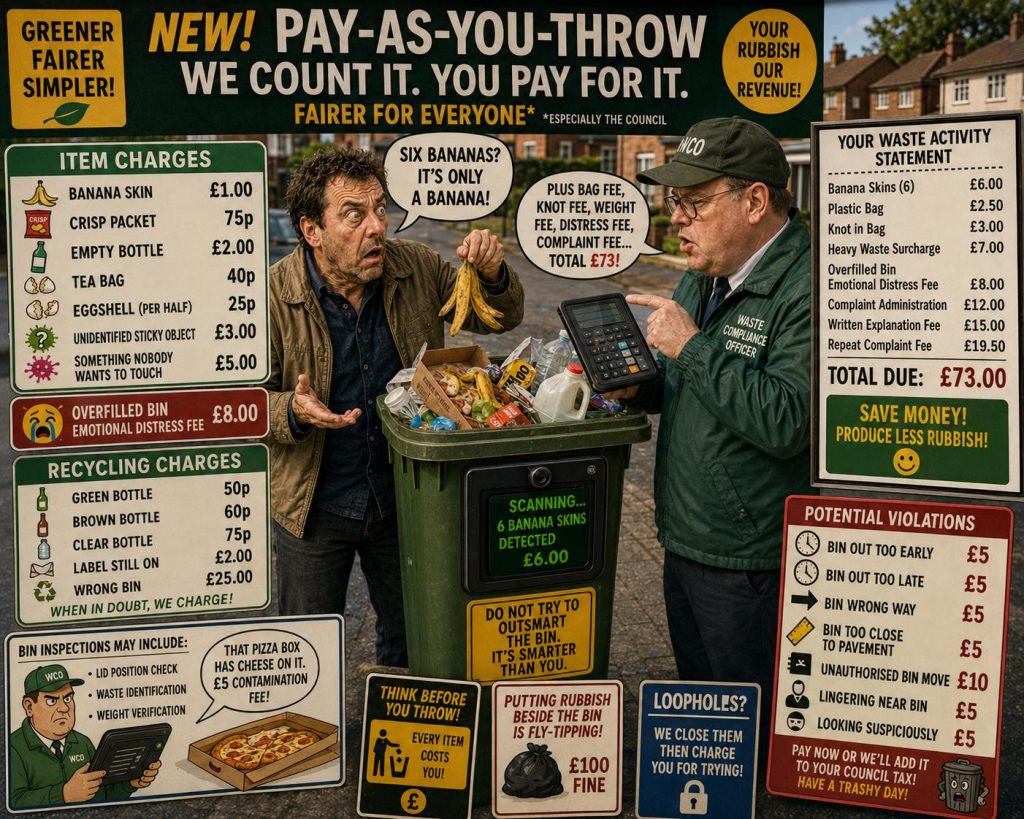
Charges include:
Banana Skin — £1
Crisp Packet — 75p
Empty Bottle — £2
Tea Bag — 40p
Eggshell — 25p per half
Unidentified Sticky Object — £3
Something Nobody Wants to Touch — £5
Albert held up an empty baked bean tin.
“How much?”
Percy consulted his tablet.
“£1.50.”
Albert crushed it.
Percy tapped the screen again.
“Compact Waste Modification Fee. Another £2.”
Albert stopped crushing it.
The Overfilled Bin Emotional Distress Fee
Residents whose bin lids don’t close completely are charged an additional £8.
The council calls this the:
Overfilled Bin Emotional Distress Fee.
Albert asked whose emotions were being distressed.
“The bin collector’s.”
“What happens?”
“They see the lid sticking up.”
“And?”
“It can be upsetting.”
Albert looked towards a refuse collector.
He seemed reasonably cheerful.
Percy lowered his voice.
“Some hide it better than others.”
Mrs Crumble’s £73 Banana
Pensioner Edith Crumble became one of the scheme’s first victims after throwing away a bunch of overripe bananas.
There were six bananas.
The council charged her £6.
Unfortunately, Edith had placed the bananas inside a plastic bag.
Plastic Bag Containment Fee — £2.50
She tied a knot in the bag.
Waste Security Modification — £3
The bag was then deemed overweight.
Heavy Rubbish Supplement — £7
Her bin lid remained open by approximately two centimetres.
Emotional Distress Fee — £8
Edith complained.
Complaint Administration Fee — £12
She requested a written explanation.
Written Explanation Fee — £15
She telephoned again.
Repeat Complaint Fee — £19.50
By Friday, Edith’s six banana skins had cost £73.
She has now stopped eating fruit.
Recycling Is Cheaper
Percy explained that residents could avoid some charges by recycling.
Albert was impressed.
“So recycling is free?”
Percy laughed.
“Good heavens, no.”
Recycling has its own price structure.
Green Bottle — 50p
Brown Bottle — 60p
Clear Bottle — 75p
Bottle With Label Still Attached — £2
Bottle in Wrong Recycling Bin — £25
Albert held up a wine bottle.
“What colour is this?”
“Dark green.”
“So 50p?”
Percy examined it carefully.
“Technically that’s Forest Emerald.”
Albert waited.
“Specialist Colour Recycling. £4.”
Bin Inspectors
The council has recruited 46 new Domestic Waste Compliance Officers.
Their job is to inspect household bins before collection.
Albert watched one officer open a resident’s wheelie bin.
He removed a yoghurt pot.
“Incorrectly rinsed.”
£10 fine.
He found an envelope.
“Window not removed.”
Another £10.
Then he discovered a pizza box.
The officer became extremely serious.
“Cheese contamination.”
The homeowner appeared at the door.
“It’s just a tiny bit of cheese!”
The officer shook his head.
“That’s how it starts.”
Albert Finds a Loophole
Albert studied the regulations carefully.
They only applied to rubbish placed inside council bins.
So Albert placed his rubbish beside the bin.
Percy smiled.
“Fly-tipping.”
£100 fine.
Albert put it back inside.
“Waste Re-entry Fee.”
£5.
Albert removed it again.
“Repeated Waste Handling.”
£7.
Albert stopped moving.
Percy looked at his tablet.
“Obstructing the Waste Assessment Process.”
£15.
Albert put his hands in his pockets.
It seemed cheaper.
Missing Collection
On Thursday morning, Albert put his bin outside at 6:45 a.m.
The collection lorry arrived at 7:10.
It drove straight past.
Albert telephoned the council.
“My bin hasn’t been emptied.”
“Was it correctly positioned?”
“Yes.”
“Handle facing the property?”
“Yes.”
“Lid completely closed?”
“Yes.”
“Placed outside before 7 a.m.?”
“Yes.”
There was a pause.
“Ah.”
“What?”
“Your bin was too close to the pavement.”
“How close?”
“Approximately four centimetres.”
Albert stared at the telephone.
“So what happens now?”
“We’ll collect it next week.”
“Do I get a refund?”
The woman laughed so loudly Albert had to move the phone away from his ear.
The Ultimate Discovery
Albert eventually asked Percy how much money the new system would raise.
“Approximately £4.2 million annually.”
“And how much does it cost to operate?”
Percy smiled proudly.
“£6.8 million.”
Albert stopped writing.
“So the council is losing £2.6 million?”
“Yes.”
“Why not just go back to collecting rubbish normally?”
Percy looked horrified.
“We’ve already spent £3 million on the bins.”
Albert nodded.
There are moments in investigative journalism when everything suddenly makes sense.
This wasn’t one of them.
DODGY RATING: 10/10
Albert awarded maximum marks after receiving his first monthly Waste Activity Statement.
Banana skins — £4
Tea bags — £8.40
Crisp packets — £3
Baked bean tin — £1.50
Bin opening fee — £2
Bin closing fee — £2
Waste assessment — £6
Environmental administration — £4.50
TOTAL: £31.40
At the bottom was a final message:
SAVE MONEY — PRODUCE LESS RUBBISH!
Attached to the message were six pages of council leaflets explaining how to produce less rubbish.
Albert attempted to put them in the recycling bin.
His smart bin immediately beeped:
COUNCIL LEAFLET DISPOSAL DETECTED.
OFFICIAL DOCUMENT RECYCLING FEE: £12.
Albert has decided to keep them.
They’re currently underneath the kitchen sink.
Along with the rubbish.