
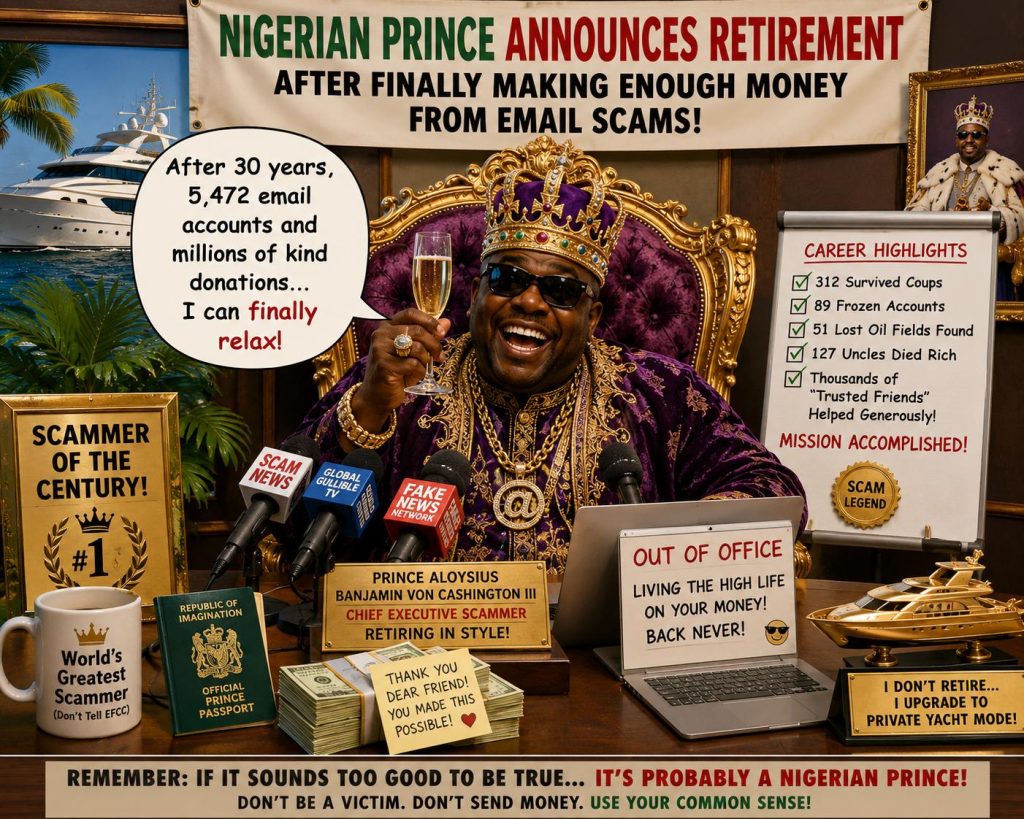
Nigerian Prince Announces Retirement After Finally Making Enough Money From Email Scams
By Albert Immerson, Chief Crime Correspondent
One of the world’s longest-serving fictional Nigerian princes has officially announced his retirement after claiming he has finally accumulated enough wealth from decades of sending improbable emails to unsuspecting internet users.
Prince Aloysius Banjamin von Cashington III, believed to be at least 147 years old according to the various birth dates he has used over the years, made the emotional announcement from his “Royal Palace,” which investigators later confirmed was a small office above a tyre repair shop.
Fighting back imaginary tears, the prince addressed reporters.
“My dear friends, it has been an incredible journey. For over thirty years I have faithfully informed millions of people that I desperately needed their help to transfer £48.7 million out of my country.”
He paused before adding proudly:
“And amazingly… some of them still believed me.”
The prince revealed that he now plans to spend his retirement enjoying a quieter lifestyle, dividing his time between luxury yachts, tropical islands and occasionally replying to spam emails himself “just to see how they feel.”
Financial experts estimate that the prince has now inherited over 4,700 different fortunes, survived 312 military coups, escaped 89 frozen bank accounts, discovered 51 lost oil fields, and had 127 wealthy uncles mysteriously die, all while somehow remaining permanently unable to pay a simple bank transfer fee.
Former colleagues praised his dedication.
“He was a true professional,” said one fellow scammer.
“Nobody could write ‘Greetings of the day, my trusted friend’ quite like Prince Aloysius.”
“He’ll be impossible to replace.”
The retirement announcement has sent shockwaves through the international scam community.
Young email scammers admit they now face fierce competition from artificial intelligence.
“Back in the old days we had to type every unbelievable story ourselves,” complained one trainee.
“Now AI can invent five royal families, three civil wars and twelve hidden fortunes before lunch.”
The prince dismissed suggestions that AI had forced him into retirement.
“Oh no,” he laughed.
“I simply reached my savings goal.”
Asked how much money that actually was, he smiled.
“I’m still waiting for one final transfer.”
Internet historians say the prince’s emails became legendary for their remarkable consistency.
Every message promised enormous riches, required absolute secrecy and always concluded with an urgent request for a modest administration fee.
Consumer groups praised the retirement.
“It marks the end of an era,” one spokesman said.
“For years, if your inbox was quiet, you could always rely on a Nigerian prince reminding you that you were his closest living relative.”
The prince insists he has no regrets.
“My only disappointment,” he admitted, “is that I never managed to convince anyone I was also a widowed astronaut stranded on the International Space Station with £200 million in gold bullion.”
As Albert Immerson prepared to leave the press conference, the prince handed him a sealed envelope.
Inside was a handwritten note that read:
“Congratulations! You have been personally selected to receive £95 million. Kindly send £27.50 for administration fees and this fortune shall be yours immediately.”
Albert later admitted he was tempted.
“After all,” he said, “it’s not every day royalty writes to you twice.”