
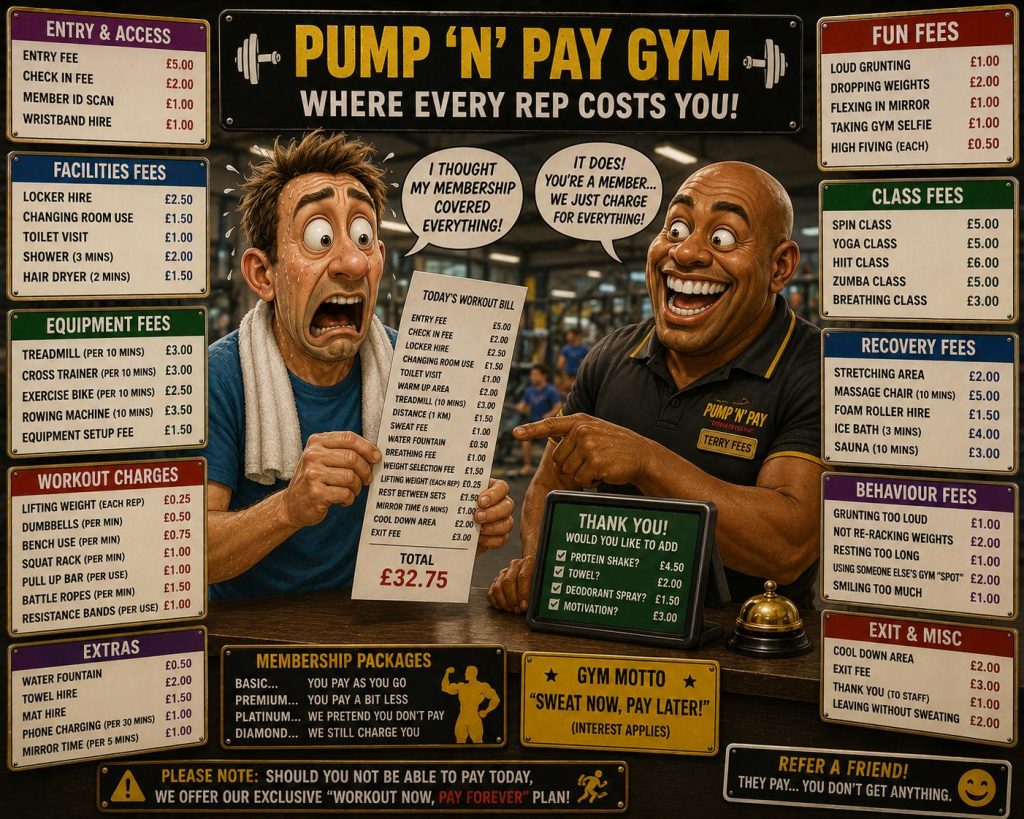
Energy Company Introduces £5 Fee for Reading Your Own Meter — “You’re Collecting Our Data for Us”
By Albert Immerson, Chief Crime Correspondent
Households have reacted with disbelief after an energy company introduced a new charge for customers who read their own electricity meters.
The revolutionary scheme has been launched by BrightSpark Energy, whose latest advertising campaign proudly declares:
SAVE MONEY — SEND US YOUR OWN METER READINGS!
Customers who do exactly that are charged £5.
BrightSpark calls it the:
Independent Data Collection Fee.
Albert Immerson immediately went to investigate.
He switched the lights off first.
He wasn’t taking any chances.
Albert Reads His Meter
Albert received an email:
YOUR METER READING IS DUE.
Please send us an accurate reading to avoid an estimated bill.
Albert walked outside, opened the meter cupboard and wrote down:
18472
He entered it on BrightSpark’s website.
A message appeared:
THANK YOU FOR YOUR METER READING.
Then:
INDEPENDENT DATA COLLECTION FEE — £5
Albert stared at the screen.
He telephoned customer services.
After 38 minutes, Sally Kilowatt answered.
“BrightSpark Energy. How may I help?”
“You’ve charged me £5 for reading my own meter.”
“Correct.”
“But I did the work.”
“Yes.”
“So why am I paying YOU?”
Sally explained patiently.
“You collected information belonging to BrightSpark.”
Albert looked at his electricity meter.
“It’s attached to my house.”
“Correct.”
“And I read it.”
“Yes.”
“And then I gave the information to you.”
“Exactly.”
“So shouldn’t you pay me?”
There was a long silence.
“That isn’t currently one of our tariffs.”
Let Us Read It Instead
Albert asked whether BrightSpark could send somebody to read the meter.
“Certainly.”
“Is that free?”
“Meter Reader Visit — £15.”
“So my choices are £5 to read it myself or £15 for you to read it?”
“Yes.”
“What if I don’t send a reading?”
“We estimate your usage.”
“Is that free?”
“Estimated Reading Administration — £8.”
Albert made a note.
There appeared to be no option involving zero pounds.
The Smart Meter Solution
Sally had good news.
“We can install a smart meter.”
“Excellent. Then I won’t need to send readings.”
“Exactly.”
“How much?”
“Installation is free.”
Albert became suspicious.
“Completely free?”
“Absolutely.”
Two weeks later, an engineer installed the meter.
Albert received his next bill.
SMART METER DATA RECEIVING FEE — £4.99
He telephoned Sally.
“You’re charging me because the smart meter sends you the reading automatically?”
“Yes.”
“But I don’t do anything!”
“That’s the convenience.”
“Convenience for whom?”
“Mostly us.”
Electricity Packages
BrightSpark had also introduced several new tariffs.
BASIC ELECTRICITY
Electricity supplied to property.
ELECTRICITY PLUS — £9.99/month
Electricity actually reaches your sockets.
ELECTRICITY PREMIUM — £19.99/month
Includes evenings and weekends.
ELECTRICITY PLATINUM — £29.99/month
Unlimited access to electricity you’ve already paid for.
Albert asked Sally what happened with Basic Electricity.
“We deliver it to your house.”
“And then?”
“Socket access is optional.”
The Light Switch Charge
Albert thought she was joking.
Then his new smart meter app updated.
LIGHT SWITCH ACTIVITY DETECTED
Living Room — 6 activations
Kitchen — 11 activations
Bedroom — 4 activations
Bathroom — 7 activations
SWITCHING ADMINISTRATION — 10p EACH
Total: £2.80.
Albert called again.
“You’re charging me for turning my lights on?”
“Not exactly.”
“What am I paying for?”
“Recording that you’ve turned them on.”
“I don’t WANT you to record it.”
“Data Recording Opt-Out — £3.99 a month.”
Peak-Time Breathing
BrightSpark’s new dynamic pricing system means electricity becomes more expensive when demand is high.
Between 5 p.m. and 8 p.m., Albert discovered that:
Boiling a kettle cost 40p.
Using the oven cost £1.20.
Running the washing machine cost £1.50.
Watching television cost 35p.
Charging his phone cost 20p.
Albert asked Sally:
“What electrical appliances can I use cheaply between five and eight?”
She thought for a moment.
“Have you considered a candle?”
Standing Charge
Albert examined his bill.
Electricity used: £42
Standing Charge: £18
He telephoned again.
“What exactly is the standing charge?”
“It’s the charge for having electricity available.”
“But I’ve already paid for the electricity.”
“Yes.”
“So I’m paying once for electricity and again because electricity exists?”
“Essentially.”
Albert sat down.
His phone beeped.
BrightSpark’s app displayed:
CUSTOMER NO LONGER STANDING.
Unfortunately, the standing charge remained.
Solar Panels
Albert decided to beat the system by installing solar panels.
Six months later, his panels were generating more electricity than he needed.
“Excellent,” Albert told Sally. “Now you can pay ME for electricity.”
“Certainly.”
“How much?”
“We’ll buy your surplus electricity for 5p per unit.”
“And how much do you charge me when I buy electricity from you?”
“Thirty pence.”
“So you buy mine for 5p and sell it back for 30p?”
“Yes.”
“That’s quite a business.”
“Thank you.”
Albert heard a keyboard click.
“Did you just charge me for saying that?”
“No.”
Albert relaxed.
“Compliments remain free.”
For now.
The Direct Debit
BrightSpark informed Albert that his monthly direct debit was increasing from £90 to £180.
Albert called Sally.
“Why?”
“We predict your energy consumption will increase.”
“But it hasn’t.”
“No.”
“And I’m using LESS electricity.”
“Yes.”
“So why double my payment?”
“To prevent you falling into debt.”
“But doubling my payment puts YOU £500 in credit.”
“Correct.”
“So you have my money?”
“Yes.”
“Can I have it back?”
“Certainly.”
Albert smiled.
“Refund Processing Fee — £25.”
Albert stopped smiling.
Leaving BrightSpark
Albert decided to switch energy suppliers.
Sally sounded disappointed.
“We’re sorry to lose you.”
“I’m sure.”
“There will be a Final Account Closure Fee.”
“How much?”
“£35.”
“What if I stay?”
“Annual Loyalty Administration Fee — £30.”
Albert paused.
“So leaving costs £35 and staying costs £30?”
“Yes.”
“What do you recommend?”
“Staying.”
“Why?”
“We make £5 less.”
Albert appreciated her honesty.
The Final Bill
Albert’s electricity usage that month came to £42.
His complete bill read:
Electricity — £42
Standing charge — £18
Meter reading — £5
Smart meter data — £4.99
Light switch activity — £2.80
Peak-time usage — £14.20
Direct debit administration — £3
Paperless billing — £2
Account maintenance — £4
Environmental contribution — £3.50
Explaining environmental contribution — £1
TOTAL: £100.49
Albert telephoned Sally.
“My electricity costs £42, but my bill is £100.49.”
“Yes.”
“So more than half my bill isn’t electricity.”
“Correct.”
“What am I actually paying for?”
Sally replied:
“The electricity experience.”
DODGY RATING: 10/10
Albert awarded maximum marks after BrightSpark announced its latest money-saving initiative:
ZERO ENERGY TARIFF — £24.99 A MONTH
Customers receive absolutely no electricity.
Albert was intrigued.
“If I receive no electricity, what does the £24.99 pay for?”
“Membership.”
“Membership of what?”
“BrightSpark.”
“What do I get?”
“Nothing.”
Albert paused.
“At least that’s clear.”
He signed up immediately.
The following morning, Albert received an email:
WELCOME TO ZERO ENERGY!
Your first monthly payment: £24.99
Underneath was another charge:
ELECTRICITY NON-USAGE FEE — £6.
Albert telephoned Sally.
“How can you charge me for NOT using electricity?”
Sally sounded surprised by the question.
“Mr Immerson, if everybody stopped using electricity, we’d go out of business.”
Albert couldn’t argue with that.
He has now disconnected his house from the grid entirely.
BrightSpark sent him one final invoice:
DISCONNECTION SUCCESS FEE — £49.99
Albert has bought a candle.
Unfortunately, BrightSpark has just announced plans to enter the candle market.